Last night at Ad Council it was brought up that what our church needed was an elevator speech...(aka: a mission statement). A neatly wrapped statement so pretty and appealing that such a statement could harness the marketing power to sell our church to even the most skeptical buyer.
Although we might all call this presentation by different names, the idea is not a unique request. In a postmodern age, Churches are constantly grappling with how to articulate a fluid identity in an institution that no longer is defined by a single experience.
While I am no social scientist, I would guess that the desire for a 'marketing plan' is probably a natural reaction to the anxiety of a changing cultural. A culture in which the church is facing the realities of an increasing sense of irrelevance. It makes sense that the Church would wish to define itself in the midst of a crumbling foundation. That we would want to convince ourselves that if we could just tell people in the right way, at the right time, how wonderful our church is then they would quietly sit in the church pew. This has become our new idea of salvation. God, give us the words to save us from a faith which calls us to change and challenge.
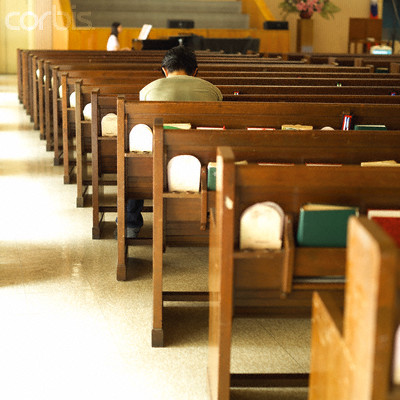
Looking out on the church pews, though, it is obvious that God's activity is calling us to do just what we are crying out against: To Change. That in spite of our best efforts and greatest intentions it will take much more than any elevator speech, mission statement, or marketing campaign to revive our churches.
But before any growth or vitality can begin to invade the Church as we know it, there will need to be a fundamental conversion experience in which the people sitting in the pews desire to come alive in Christ. A conversion experience which inspires action and redirects us toward a new conversation. One that values deed over word, faith over predictions, outreach over isolation, heterogeneity over homogeneity.
It will be that experience through which our hearts begin to adjust to God's action in the world, showing us its time to get off the elevator and start learning to take the stairs. It's a longer, more demanding process. It requires intentionality, training, and courage. But it also reflects the reality of Christ's call to live as Disciples, having faith that God will take care of the church. Accepting that we are to care for the world.
Perhaps our first step upward on God's path is to do the exact opposite of what our anxieties tell us we need. That in the presence of faith we would choose to find peace living in the walls of an institution and not knowing quite who we are. Embracing that we are a struggling community living in anxiety and fear but that in the face of individual death and institutional extinction we remain committed to physically beginning a new journey toward a vision of Hope.
Our mission statement might just be that we are going to live as a physical sign of God's love in the world and that in this action of outreach and mission we have faith that God will make clear the identity of Her Church in this new world. Our elevator speech, however, well, that will have to be our visible actions...
Thoughts and ideas for life and ministry. Compliments to the Holy Spirit. From a girl who knows how to type.
Wednesday, May 25, 2011
Saturday, May 14, 2011
My Kid is Off Limits!
Today Hope UMC hosted a half day workshop called "Parenting Safe Children" which focused on education about how to reduce the risk of our children being victims of sexual abuse. The premise: If you know what makes your child vulnerable to being sexually abused and you can educate yourself and your child to eliminate those vulnerabilities, the chances of your child being a victim are reduced exponentially. This isn't a workshop guaranting to prevent a child from being sexually abused. Parents can do everything right and something can still happen. But it IS a workshop that promises to reduce the chances of your child will be seen as vulnerable by a sexual perpetrator and therefore will reduce the chances of your child being harmed.
For about the first half of the workshop I will be quite honest, I had a hard time not breaking out in tears. Hearing spoken out loud the statistics that one in three girls and one in seven boys will be victims of sexual abuse before the age of 18...and that is JUST the kids who will report the crime...was overwhelming. Knowing that most children will never tell and that that statistic is probably incredibly lower than the reality, is heart breaking. The other staggering fact I learned was that most sexual perpetrators begin abusing children around age 14 and that half of all sexual perpetrators are teenagers. It was into about an hour of the workshop that I decided Fiona would be home schooled with limited contact with other children, teens or adults.
But then a funny thing happened. After the frightening reality set in that this could happen to my daughter, I was so willing and ready to digest all of the information about how we could do all of these everyday things to help keep her safe. And while they might seem simple or common sense, they aren't. Socially acceptable behavior, a broken legal system, and a fragmented society have all worked together effectively to create a world in which our children are incredibly vulnerable and horribly exposed to being sexually abused. Preventing it takes courage, intentionality, and education. We worry so much about our kids behaving, being smart, achieving ambitious goals in sports and school, but then when it comes to providing them with the tools to ward off sexual predators we are quick to let it pass by the way side thinking that, in spite of the jaw dropping statistics, it won't happen to our kid.
It's not a popular conversation.
And in light of all the ignorance, denial, and distraction, I am proud of our church for providing a forum for such a conversation. It had its tough moments. You think of yourself as a mature professional adult until someone asks you to role play telling your child what sex is or where babies come from. And then, you glaze over, giggle, and if you're lucky find words to awkwardly stumble over. These are sacred conversations. I wish it could be a requirement for everyone to take this workshop, not just parents, but all members of a community which values the sacredness of each child. Our children are at risk but there is so much we can do to protect them if we are just willing to listen and learn and laugh.
As soon as the workshop was over I approached the facilitator to schedule her to come back. I guess it's just not enough for me to say my daughter is going to have the tools she needs and the parents who will proactively support her in making her Off Limits to sexual perpetrators but I want all kids to be Off Limits kids. I want us all to be in this together....imagine that, a sacred community gathered around the most vulnerable of our clan ensuring their safety and protection...sounds, well, very Christian.
For about the first half of the workshop I will be quite honest, I had a hard time not breaking out in tears. Hearing spoken out loud the statistics that one in three girls and one in seven boys will be victims of sexual abuse before the age of 18...and that is JUST the kids who will report the crime...was overwhelming. Knowing that most children will never tell and that that statistic is probably incredibly lower than the reality, is heart breaking. The other staggering fact I learned was that most sexual perpetrators begin abusing children around age 14 and that half of all sexual perpetrators are teenagers. It was into about an hour of the workshop that I decided Fiona would be home schooled with limited contact with other children, teens or adults.
But then a funny thing happened. After the frightening reality set in that this could happen to my daughter, I was so willing and ready to digest all of the information about how we could do all of these everyday things to help keep her safe. And while they might seem simple or common sense, they aren't. Socially acceptable behavior, a broken legal system, and a fragmented society have all worked together effectively to create a world in which our children are incredibly vulnerable and horribly exposed to being sexually abused. Preventing it takes courage, intentionality, and education. We worry so much about our kids behaving, being smart, achieving ambitious goals in sports and school, but then when it comes to providing them with the tools to ward off sexual predators we are quick to let it pass by the way side thinking that, in spite of the jaw dropping statistics, it won't happen to our kid.
It's not a popular conversation.
And in light of all the ignorance, denial, and distraction, I am proud of our church for providing a forum for such a conversation. It had its tough moments. You think of yourself as a mature professional adult until someone asks you to role play telling your child what sex is or where babies come from. And then, you glaze over, giggle, and if you're lucky find words to awkwardly stumble over. These are sacred conversations. I wish it could be a requirement for everyone to take this workshop, not just parents, but all members of a community which values the sacredness of each child. Our children are at risk but there is so much we can do to protect them if we are just willing to listen and learn and laugh.
As soon as the workshop was over I approached the facilitator to schedule her to come back. I guess it's just not enough for me to say my daughter is going to have the tools she needs and the parents who will proactively support her in making her Off Limits to sexual perpetrators but I want all kids to be Off Limits kids. I want us all to be in this together....imagine that, a sacred community gathered around the most vulnerable of our clan ensuring their safety and protection...sounds, well, very Christian.
Saturday, May 7, 2011
the other mother
If there was any topic that rivaled the death of Osama bin Laden this week on Facebook it had to be opinions surrounding Mother's Day. With at least half of my FB friends being clergy persons, by the end of the week, debate regarding the recognition of Mothers and inclusion of Mother's Day traditions in religious services (not only how but if it should be done) way out numbered any posts about the death of the mastermind behind the September 11th attack ultimately incited George W. Bush to pre-emptively enter into the so-called 'War on Terror'. Still, in the midst of the news that Osama bin Laden had been located and killed in Abbottabad, Pakistan by US Navy Seals, it was ultimately Mother's Day that pushed peoples hot buttons.
As people generally culturally sensitive to the issues surrounding mother-child relationships, as well as societal pressures for women to be mothers in order to be recognized as fully 'matured' American women, clergy persons were quick to illicit opinions from friends and colleagues searching for politically correct and religiously appropriate ways to handle the holiday. Not wanting to incorporate a non-religious holiday in sacred space some clergy quickly dismissed even the idea of sharing preaching space with the troublesome Hallmark holiday. Other's more actively opposed the participation in the holiday by posting statuses refusing to participate in the honoring of any mother in order that there might be a new level of solidarity formed with women who had made 'alternative' reproductive choices. Still, some clergy had taken a historical perspective, incorporating the roots of the holiday to hold up issues of peace with justice, service and women's liberation in a time when women still live in a society which expects much and supports little.
As one who enjoys the challenge of creatively engaging secular traditions in the religious sphere, I quickly packed up my contemporary feminist worldview to head down memory lane. It didn't take more than one Google search to find what I was was looking for. A possibility. A woman named Anna Jarvis who's conception of a holiday honoring mothers and desire to drag into the public sphere issues of women's discrimination and oppression held the potential for resurrection of a holiday that had become naturally over commercialized and highly contentious among religious progressives hoping to re-envision women's role in society.
At a time when Mother's Day conjures up as much, if not more, of an emotional response than the death of Osama bin Laden, perhaps it is even more important for clergy persons to bring into the public realm of the church those issues associated with motherhood that plague the private hearts of so many. It could be an opportunity to resurrect the original purpose of an overcommercialized holiday that once sought to bring forth into the public realm the private issues that women struggle with.
Of course, first this requires us to ask the question: Why is motherhood such a hot button for our culture, not just for us as individuals but for us as a society? And, what is it about all of this that is so offensive and painful that it prevents progressive religious leaders from honoring the struggles and difficulties of mothers? That such a reaction would be cultivated that we would once again push back to an invisible place an already largely silenced position; that of the American mother. And that this reaction would then serve to do exactly the opposite of what was intended, that once again women become isolated into categories of mother and non-mother. Both being silenced. And thus, effectively separated from the support of one another over yet again another culturally created divide to keep up weak and quiet and private about obstacles we face not just as mother but as women. Women who on a daily basis fight this ideal of 'The Mother' that was designed so that no one could ever quite live up to...keeping us fighting amongst ourselves, turning away from the powerful hope of transformation found in the authentic acceptance of the broken mother inside all of us.
An Aside:
After some internal debate, tonight, at our alternative service, I will talk about Mother's Day. Not to isolate or point out differences among women but perhaps as a backward step into solidarity. What IF we could all accept in ourselves and in one another the Divine Mother in all of us? To take the countercultural stance that femininity, true gritty and vulnerable and messy femininity, is that which can be seen as Divine. To hold up this concept of God as Mother which Julian of Norwich states "demonstrates the worldly, sensual and active property of God....in the midst of suffering, illness, and pain, the Mother God says, 'All will be well. You will see it yourself, that every kind of thing will all be well." In this 'wellness' may there be the possibility of seeing outside of predetermined categories of good and bad women...but a new hope in the publicly proclaiming the Divine Mother existing in all persons and the strength that adds to our movement to be at peace with all the world's children. Perhaps, our hope is not found in the image of mother our society has painfully tattooed into our minds but that mother which God has already brought to life inside of our hearts.
As people generally culturally sensitive to the issues surrounding mother-child relationships, as well as societal pressures for women to be mothers in order to be recognized as fully 'matured' American women, clergy persons were quick to illicit opinions from friends and colleagues searching for politically correct and religiously appropriate ways to handle the holiday. Not wanting to incorporate a non-religious holiday in sacred space some clergy quickly dismissed even the idea of sharing preaching space with the troublesome Hallmark holiday. Other's more actively opposed the participation in the holiday by posting statuses refusing to participate in the honoring of any mother in order that there might be a new level of solidarity formed with women who had made 'alternative' reproductive choices. Still, some clergy had taken a historical perspective, incorporating the roots of the holiday to hold up issues of peace with justice, service and women's liberation in a time when women still live in a society which expects much and supports little.
As one who enjoys the challenge of creatively engaging secular traditions in the religious sphere, I quickly packed up my contemporary feminist worldview to head down memory lane. It didn't take more than one Google search to find what I was was looking for. A possibility. A woman named Anna Jarvis who's conception of a holiday honoring mothers and desire to drag into the public sphere issues of women's discrimination and oppression held the potential for resurrection of a holiday that had become naturally over commercialized and highly contentious among religious progressives hoping to re-envision women's role in society.
At a time when Mother's Day conjures up as much, if not more, of an emotional response than the death of Osama bin Laden, perhaps it is even more important for clergy persons to bring into the public realm of the church those issues associated with motherhood that plague the private hearts of so many. It could be an opportunity to resurrect the original purpose of an overcommercialized holiday that once sought to bring forth into the public realm the private issues that women struggle with.
Of course, first this requires us to ask the question: Why is motherhood such a hot button for our culture, not just for us as individuals but for us as a society? And, what is it about all of this that is so offensive and painful that it prevents progressive religious leaders from honoring the struggles and difficulties of mothers? That such a reaction would be cultivated that we would once again push back to an invisible place an already largely silenced position; that of the American mother. And that this reaction would then serve to do exactly the opposite of what was intended, that once again women become isolated into categories of mother and non-mother. Both being silenced. And thus, effectively separated from the support of one another over yet again another culturally created divide to keep up weak and quiet and private about obstacles we face not just as mother but as women. Women who on a daily basis fight this ideal of 'The Mother' that was designed so that no one could ever quite live up to...keeping us fighting amongst ourselves, turning away from the powerful hope of transformation found in the authentic acceptance of the broken mother inside all of us.
An Aside:
After some internal debate, tonight, at our alternative service, I will talk about Mother's Day. Not to isolate or point out differences among women but perhaps as a backward step into solidarity. What IF we could all accept in ourselves and in one another the Divine Mother in all of us? To take the countercultural stance that femininity, true gritty and vulnerable and messy femininity, is that which can be seen as Divine. To hold up this concept of God as Mother which Julian of Norwich states "demonstrates the worldly, sensual and active property of God....in the midst of suffering, illness, and pain, the Mother God says, 'All will be well. You will see it yourself, that every kind of thing will all be well." In this 'wellness' may there be the possibility of seeing outside of predetermined categories of good and bad women...but a new hope in the publicly proclaiming the Divine Mother existing in all persons and the strength that adds to our movement to be at peace with all the world's children. Perhaps, our hope is not found in the image of mother our society has painfully tattooed into our minds but that mother which God has already brought to life inside of our hearts.
Sunday, May 1, 2011
something beautiful
It's been an especially disheartening few months. "How low can we go?," has been a common question floating through my mind as I watch the wolves gathering at the political tables; so quick to panic, to blame, to withhold compassion and reason, making knee jerk decisions based on self-serving half-truths and a limited vision of the future. A scene so quick to rip away the most essential ingredients of this potential awakening from even the most bold and capable of leaders: Hope, Love, Grace, Humility.
Perhaps, as a young religious leader, what has been even more disturbing is how closely our faith communities seem to have followed, mimicking this hopeless landscape. Gathering around the committee table to blame one another for failing to meet traditional meanss of success measured in membership numbers, worship attendance, stewardship campaigns...
Yet, for many of us, in our hearts it has been made known by the Spirit's tide that we have entered an age in which none of these measurements will align our motivations with Christ's call to our communities. A time in which we are called to gather together to push open doors; welcoming among us all people as equals, stepping over denominational lines, and reaching over religious boundaries to appreciate difference and courageously set forth to learn more fully who we are called to be together as faithful people in this world. A time in which we are called to gather together and open our hearts that our mouths might pour out words of advocacy for those among us who have been unjustly treated and systematically stripped of paths upon which more privileged members of us experience that very thing which God has gifted all of us with, mercy.
It is in this call that I have found hope once again that something beautiful is growing in our midst. That beyond the death throws of the hateful voices of fearful exclusiveness and selfish intentions, we are entering an age in which liberation will be wrapped in the beauty of a new accountability for the church and its leaders. Where the life of the church will be measured purely in its active and tangible compassion toward all of humanity.
In this Great Commission of our Contemporary Times, I am no longer bound to the hopelessness provided by our institutions but have been made aware that the salvation of our churches cannot be paid with the price of our souls. Yet, if it is God's will which we pursue in our world having forsaken its own moral voice in favor of greed and judgement, then perhaps it will be the communities of faith which stand as beacons of Hope and Love in a world which has grown dark and cold to all God's suffering people. I pray that nevermore may our hearts be drowned with sadness nor our minds blinded by false hopelessness, but in the midst of hollow shouting matches we must continue to feast on a hope which will outlast those for whom hatred and greed are quickly devoured. In our boundless community of Love, let Hope be to us the body of Jesus which sustains us through all trials and surely God's love will be made known to all those who have surrendered their potentials to the lesser demands of our institutional survival.
Perhaps, as a young religious leader, what has been even more disturbing is how closely our faith communities seem to have followed, mimicking this hopeless landscape. Gathering around the committee table to blame one another for failing to meet traditional meanss of success measured in membership numbers, worship attendance, stewardship campaigns...
Yet, for many of us, in our hearts it has been made known by the Spirit's tide that we have entered an age in which none of these measurements will align our motivations with Christ's call to our communities. A time in which we are called to gather together to push open doors; welcoming among us all people as equals, stepping over denominational lines, and reaching over religious boundaries to appreciate difference and courageously set forth to learn more fully who we are called to be together as faithful people in this world. A time in which we are called to gather together and open our hearts that our mouths might pour out words of advocacy for those among us who have been unjustly treated and systematically stripped of paths upon which more privileged members of us experience that very thing which God has gifted all of us with, mercy.
It is in this call that I have found hope once again that something beautiful is growing in our midst. That beyond the death throws of the hateful voices of fearful exclusiveness and selfish intentions, we are entering an age in which liberation will be wrapped in the beauty of a new accountability for the church and its leaders. Where the life of the church will be measured purely in its active and tangible compassion toward all of humanity.
In this Great Commission of our Contemporary Times, I am no longer bound to the hopelessness provided by our institutions but have been made aware that the salvation of our churches cannot be paid with the price of our souls. Yet, if it is God's will which we pursue in our world having forsaken its own moral voice in favor of greed and judgement, then perhaps it will be the communities of faith which stand as beacons of Hope and Love in a world which has grown dark and cold to all God's suffering people. I pray that nevermore may our hearts be drowned with sadness nor our minds blinded by false hopelessness, but in the midst of hollow shouting matches we must continue to feast on a hope which will outlast those for whom hatred and greed are quickly devoured. In our boundless community of Love, let Hope be to us the body of Jesus which sustains us through all trials and surely God's love will be made known to all those who have surrendered their potentials to the lesser demands of our institutional survival.
Subscribe to:
Posts (Atom)


